


Do good
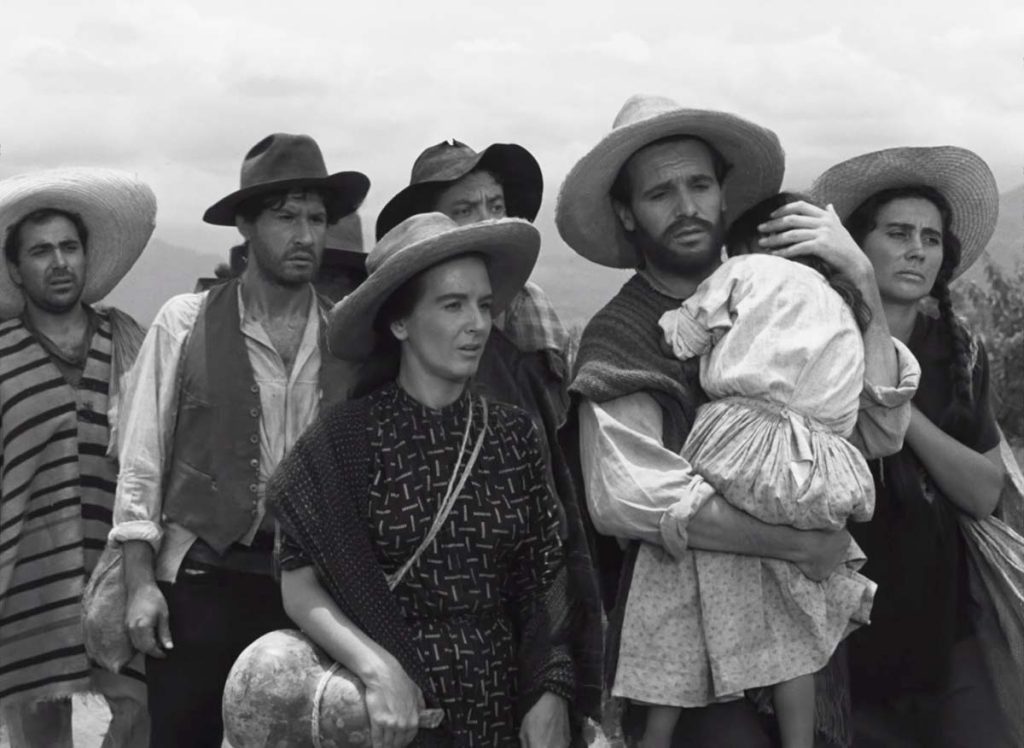
On one of those days that kept coming and coming, when “his grace” Bibi lost it, yet again, and declared in an unforgettable speech to the nation that we had better prepare for this wonderful future awaiting us – as if we were modern-day Sparta, isolated, and thus adopting autarky, like North Korea or South Africa of yesteryear – I was trying to escape to, to find solace in, a film, one by Luis Buñuel that I hadn’t yet seen, called Nazarín. As I’ve already watched so many of Buñuel’s films, I was no stranger to his themes, but still at times while watching this piece, I asked myself what I was doing there: what this priest, trying to live according to the spirit of the gospel, treating each and every one with the utmost kindness and benevolence, had to do with our sick society, where man devours man. Even the villains in that film seemed rather innocent next to our present-day everymen, constantly measuring themselves against the perceived ideal of absolute goodness, the clerical demand for repentance, and the long-standing conviction that life’s highest aim is the ceaseless striving for moral perfection.
We are witnessing a journey, a bittersweet one, where the ideal keeps clashing with reality, and while tragedy is anticipated from the very beginning, the course it is yet to take becomes evident only as the film approaches its closure. Where the truth about human nature lies, maybe with the criminal who speaks to our priest in prison. His wording may seep deep into our priest’s soul, evoking a sense of awakening at the film’s final scene, when our rebel priest walks off into the unknown holding a pineapple in his hand – one he finally consented to take, only after the street vendor’s third attempt. This person tried to embody the Christian grace in the utmost total way possible, almost like a desert hermit (the hero of Buñuel’s other film), only to find the church establishment amazed by his conduct, its officials calling him a crazy preacher from the north, or mistaking him for being an Orthodox rather than Catholic. Priests, after all, are not meant to strive only for the total fulfillment of Christ’s sermons; they should also preserve the dignity of their office and of the Church itself. Like the colonel Nazarín encounters on his way, who forces a passer-by peasant to show respect both to himself and to the clergyman accompanying him, a clergyman who assumes his status merely by wearing the garments associated with his office.
This burning religious zeal reminded me of another priest who went mad, better known to us as a painter – Vincent van Gogh. He too worked among the poor as an uncertified preacher, and when dismissed, continued to give sermons without pay. If you know his paintings, you can see that same fervor, I think. Though perhaps his early works relate more directly to that period in his life – for example, The Potato Eaters (1885), the later, colorful ones still carry within them that same obsessive passion that never found rest, evident in the brushstrokes themselves. That, after all, is the name of the game: obsession.
Some may hold this film as a satire, or at least that’s what was more evident when it was released in 1959. But today, the tension between the aspired pursuit of the ultimate moral good conduct (according to the church) and the temptation to commit sins, or in other words – simply surviving, feels so detached from our present lives, that more than satire on church hypocrisy, or a critique of people’s strange choices when they cannot truly choose between good and evil (for instance, the plague-stricken woman who prefers her earthly lover talking to her over the last rites the priest offers her – redemption of her soul before death – in a direct reference to the Marquis de Sade’s Dialogue Between a Priest and a Dying Man), more than a debate on these themes, the film testifies to our era’s collapse of any value system by which “good” or “evil” can even be measured.

For, in times when the most important things one is urged to pursue are money, honor, and power (the 3 Ps – Profit, Prestige, and Power), it’s not clear whether these values in themselves are the ultimate good or the ultimate evil. What once counted as mortal sins has today become noble goals, one may ponder the whereabouts of yesteryear’s valued traits – honesty, integrity, social solidarity, care for others and for the community. In this film, the worst of criminals seem rather innocent, always measuring themselves against the Church’s teaching of virtues vs sins. The value system of the old meta-narrative is still there peeping through, and stands in striking contrast to present everyman’s prevailing narrative, for whom money, power, and influence have become the true essence of existence. So much so that one encounters its reflection in what the children of today aspire to become: responding to the staple question “What would you like to be when you grow older?” they reply: “make money and become social-media influencers”. And if money and influence are the “good”, then corruption is permissible, disregard for the law is admirable, and anyone who is powerful enough can trample the law and rewrite it according to his personal interests. Those are the people who are left with no God at all… (whether or not they attend mass every Sunday).
Even in Israel, the festering pus of money–power–influence leaves behind two camps equally confused: on one side, the liberal-socialist individuals (whether they explicitly declare themselves as such or not), who seem to have lost their way against the brutal attack on what was perceived to be an axiomatic moral code, and have found themselves in a state of great perplexity; and on the other side, the religious-Jewish people, who also seem to have forgotten what it means to be Jewish, what love your neighbor as yourself means, and have also embraced money–power–influence in order to extort lavish benefits, whose pursuit hardly seems motivated by, or even coincides with, any genuine Jewish sentiment of the ultimate good. And no – Torah study is not the ultimate good according to Judaism. There are several good qualities that precede it. What we call derekh eretz – proper human conduct.
Christian proper human conduct has always seemed exaggerated to us Jews – turning the other cheek, or the deep forgiveness one is expected to extend even toward the most immoral and exploitative offender, in order to bring this person to repent. Maybe Buñuel’s critique here, and elsewhere in his work, was aimed at the futility of this exact behavior. The film’s hero is a priest who simply gives away everything he has, until he doesn’t even notice he is being robbed; his flat is entered through a window and not through its door (a door we never see and whose existence we learn of only when he speaks about it, apologetically asking the clergy paying a visit to act as accustomed). He shelters a wounded murderess, who repays him by burning the little he has left “to erase the scent of her presence there.” When a great scandal breaks, he is no longer welcome to stay even with his long-time wealthy patron and supporter, who took him in after the fire, and he is forced to wander and beg.
His journey brings him to a village where he happened to be reunited with the prostitute he once hid and her friend, both of whom he knew from Mexico City. After he “cured” a sick child and was deemed a miracle worker, they decided to join his ministry, seeking total repentance, but in the eyes of most people they were simply a man living in sin with two women. Like Martha and Mary, the companions of Jesus, they drew a sense of goodness from him but couldn’t realize it themselves. And so, the murderess developed a sort of romance with a dwarf who fell in love with her because she was ugly, but her fate would likely be one befitting a murderess – we can’t really tell, Buñuel leaves it to us to imagine and all we see is a prisoners’ march à la Manon Lescaut. Her friend, troubled by her mother’s harsh and abusive words and realizing she is in love with the priest in a carnal, earthly way, suffers another psychotic fit (back then in cinema, this was a sign of a woman unable to free herself from oppressive narratives), chooses to return to her exploitative and treacherous lover, despite having rejected him earlier, and even consoles herself in doing so.
And so we return to the man and the pineapple – in the tradition of characters walking at the end of films, an ending that signals a new awareness arising out of downfall and chaos (see also Nights of Cabiria / Fellini). A place we can only dream of today.

